Prussia
(prŭsh`ə), Ger. Preussen, former state, the largest and most important of theGerman states. Berlinwas the capital. The chief member of the German Empire (1871–1918)and a state of the Weimar Republic (1919–33), Prussia occupied more than half of allGermany and the major part of N Germany. Before 1919 it consisted of 13 provinces: Berlin,Brandenburg
, East Prussia
(separated after 1919 from the rest of Prussia by the Polish Corridor
), Hanover
, Hesse-Nassau (see Hesse
), Hohenzollern
(a Prussian enclavebetween Württemberg and Baden in SW Germany), Pomerania
, Rhine Province
, Saxony
,Schleswig-Holstein
, Upper Silesia and Lower Silesia, and Westphalia
. (Grenzmark Posen–West Prussia was sometimes considered a 14th province.) Prussia surrounded severalsmaller German states and stretched from the borders of the Netherlands, Belgium, andLuxembourg in the west to those of Lithuania and Poland in the east, and from the Baltic Sea,Denmark, and the North Sea in the north to the Main River, the Thuringian Forest, and theSudetes Mts. in the south.
The region that was Prussia is made up mainly of low-lying land, drained by several rivers,notably the Rhine; the Weser; the Oder; and the Elbe, which divided the state into roughlyequal eastern and western parts. After Berlin, the largest cities of the area were Cologne,Breslau (Wrocław), Essen, Frankfurt, Düsseldorf, Hanover, Dortmund, Magdeburg, andKönigsberg (Kaliningrad). The region also included the gigantic industrial Ruhr
district.
district.
Industrially and politically the most prominent state of Germany prior to World War II, Prussiawas partitioned among the four Allied occupation zones after 1945. In 1947 the Allied ControlCouncil for Germany formally abolished the state of Prussia. This action not only confirmed anaccomplished fact; it was also intended as a blow against the spirit of German militarism andaggression, long held to be connected with Prussia. Most of the former Prussian provincesbecame part of the new states of the Federal Republic of Germany and of the GermanDemocratic Republic (now reunified). The USSR annexed the northern part of East Prussia;Poland acquired the rest of East Prussia, as well as all Prussian territory E of the Oder andNeisse rivers.
History
Growth of Brandenburg-Prussia
Prussia in its modern meaning came into existence only in 1701, when the elector ofBrandenburg assumed the title "king in Prussia." Before then Prussia meant only the flat,sandy region later known as East Prussia (excluding the bishopric of Ermeland
), separatedfrom Brandenburg by a part of Poland (later known as West Prussia) and bordering on theBaltic Sea. The original inhabitants, the Borussi (or Prussians), were of Baltic stock. Theywere conquered and largely exterminated by the Teutonic Knights
in the 13th cent. TheKnights effected the Germanization of Prussia.
), separatedfrom Brandenburg by a part of Poland (later known as West Prussia) and bordering on theBaltic Sea. The original inhabitants, the Borussi (or Prussians), were of Baltic stock. Theywere conquered and largely exterminated by the Teutonic Knights
in the 13th cent. TheKnights effected the Germanization of Prussia.
Through the secularization (1525) of the domain of the Teutonic Order by the grand masterAlbert of Brandenburg
, the domain became a hereditary duchy under Polish suzerainty,ruled by a branch of the Hohenzollern dynasty of Brandenburg. In 1618 the duchy of Prussiapassed through inheritance to the elector of Brandenburg, and in 1660, by the treaty of Oliva
,full independence from Polish suzerainty was confirmed to Frederick William
, the GreatElector. In the course of the 17th cent. the electors of Brandenburg directed themselveswestward, acquiring the duchy of Cleves
, together with the counties of Mark and Ravensberg(1614) and the bishoprics of Minden, Magdeburg, and Halberstadt (1648). In the east,Brandenburg gained (1648) Farther (i.e., eastern) Pomerania, which connected it with theBaltic Sea but not with Prussia.
, the domain became a hereditary duchy under Polish suzerainty,ruled by a branch of the Hohenzollern dynasty of Brandenburg. In 1618 the duchy of Prussiapassed through inheritance to the elector of Brandenburg, and in 1660, by the treaty of Oliva
,full independence from Polish suzerainty was confirmed to Frederick William
, the GreatElector. In the course of the 17th cent. the electors of Brandenburg directed themselveswestward, acquiring the duchy of Cleves
, together with the counties of Mark and Ravensberg(1614) and the bishoprics of Minden, Magdeburg, and Halberstadt (1648). In the east,Brandenburg gained (1648) Farther (i.e., eastern) Pomerania, which connected it with theBaltic Sea but not with Prussia.
Rise of the Prussian State
The electorate with its dependencies had become a major German state by the end of the17th cent., a position that it owed largely to the secularization of church lands during theReformation (the major part of its new acquisitions had been ecclesiastic territory) and to itssuccessful diplomacy at the Peace of Westphalia (1648). In 1701, Elector Frederick III hadhimself crowned "king in Prussia" at Königsberg (Kaliningrad) and styled himself KingFrederick I
. He remained a prince of the Holy Roman Empire by virtue of his rank as margraveand elector of Brandenburg and his holdings within the empire, but not as king of Prussia,which lay outside the imperial boundaries. This technicality gave the kings of Prussia ameasure of independence from the emperor not possessed by the other princes of the empire.
. He remained a prince of the Holy Roman Empire by virtue of his rank as margraveand elector of Brandenburg and his holdings within the empire, but not as king of Prussia,which lay outside the imperial boundaries. This technicality gave the kings of Prussia ameasure of independence from the emperor not possessed by the other princes of the empire.
As a result of the Northern War
, Prussia gained (1720) the eastern part of SwedishPomerania (including Stettin). In the following 20 years, however, King Frederick William I
,the true creator of the Prussian state, avoided military ventures and used diplomacy in order tocreate a unified state. He fully developed the features that had distinguished Prussia since thetime of the Great Elector. The army, necessary to defend Prussia's scattered lands, was alsothe chief force in unifying and shaping the state. In order to build a strong army in theirrelatively poor country, Prussia's rulers developed a government-controlled economy and anobedient central bureaucracy (the Generaldirektorium). The landed aristocrats, the Junkers,were brought into military and state service and in turn were left free to enserf their peasants.
, Prussia gained (1720) the eastern part of SwedishPomerania (including Stettin). In the following 20 years, however, King Frederick William I
,the true creator of the Prussian state, avoided military ventures and used diplomacy in order tocreate a unified state. He fully developed the features that had distinguished Prussia since thetime of the Great Elector. The army, necessary to defend Prussia's scattered lands, was alsothe chief force in unifying and shaping the state. In order to build a strong army in theirrelatively poor country, Prussia's rulers developed a government-controlled economy and anobedient central bureaucracy (the Generaldirektorium). The landed aristocrats, the Junkers,were brought into military and state service and in turn were left free to enserf their peasants.
Frederick William's successor, Frederick II
, or Frederick the Great (reigned 1740–86), usedthe efficient military instrument bequeathed him by his father to enter upon a period ofconquest. On a slim pretext (see Silesia
) and without a declaration of war, he invaded (1740)Austrian territory, thus gaining the initiative in the War of the Austrian Succession
(1740–48).Acting with utter disregard for its allies, Prussia got out of the war in 1742 by the Treaty ofBerlin, reentered it in 1744, and quit again in 1745 at the Treaty of Dresden. In both treatiesMaria Theresa of Austria was forced to cede nearly all of Silesia to Prussia. Although it gainedno additional territory in the Seven Years War
(1756–63), Prussia emerged from the war asthe chief military power of the Continent. By the partition of Poland of 1772 (see Poland, partitions of
) Prussia gained Pomerelia (except Danzig) and Ermeland. Pomerelia wasorganized into the province of West Prussia
, and the original Prussia became known as EastPrussia.
, or Frederick the Great (reigned 1740–86), usedthe efficient military instrument bequeathed him by his father to enter upon a period ofconquest. On a slim pretext (see Silesia
) and without a declaration of war, he invaded (1740)Austrian territory, thus gaining the initiative in the War of the Austrian Succession
(1740–48).Acting with utter disregard for its allies, Prussia got out of the war in 1742 by the Treaty ofBerlin, reentered it in 1744, and quit again in 1745 at the Treaty of Dresden. In both treatiesMaria Theresa of Austria was forced to cede nearly all of Silesia to Prussia. Although it gainedno additional territory in the Seven Years War
(1756–63), Prussia emerged from the war asthe chief military power of the Continent. By the partition of Poland of 1772 (see Poland, partitions of
) Prussia gained Pomerelia (except Danzig) and Ermeland. Pomerelia wasorganized into the province of West Prussia
, and the original Prussia became known as EastPrussia.
Frederick was succeeded (1786) by Frederick William II
, who further added to Prussia bythe partitions of Poland of 1793 and 1795. However, under his rule and that of his successor,Frederick William III
(1797–1840), Prussia underwent a period of eclipse as a result of theFrench Revolutionary Wars
and the wars of Napoleon I
. Defeated by the French, Prussiawithdrew from the antirevolutionary coalition in the Treaty of Basel (1795) and remained neutraluntil 1806. Its armies were crushed by Napoleon in the twin battles of Jena and Auerstedt, andin 1807 Prussia had to accept the harsh Treaty of Tilsit, by which it lost all lands W of theElbe and most of its share of Poland and became a virtual dependency of France.
, who further added to Prussia bythe partitions of Poland of 1793 and 1795. However, under his rule and that of his successor,Frederick William III
(1797–1840), Prussia underwent a period of eclipse as a result of theFrench Revolutionary Wars
and the wars of Napoleon I
. Defeated by the French, Prussiawithdrew from the antirevolutionary coalition in the Treaty of Basel (1795) and remained neutraluntil 1806. Its armies were crushed by Napoleon in the twin battles of Jena and Auerstedt, andin 1807 Prussia had to accept the harsh Treaty of Tilsit, by which it lost all lands W of theElbe and most of its share of Poland and became a virtual dependency of France.
Prussia was fortunate to possess, at this low ebb in its history, such able and energeticreformers as Karl vom und zum Stein
, Karl August von Hardenberg
, and Wilhelm vonHumboldt
. These men helped transform Prussia into a progressive state by abolishingserfdom and nobiliary privileges, introducing agrarian and other social and economic reforms,and laying the groundwork for an exemplary system of universal education. Gerhard vonScharnhorst
and August, Graf von Gneisenau
at the same time put the Prussian army on amodern basis.
, Karl August von Hardenberg
, and Wilhelm vonHumboldt
. These men helped transform Prussia into a progressive state by abolishingserfdom and nobiliary privileges, introducing agrarian and other social and economic reforms,and laying the groundwork for an exemplary system of universal education. Gerhard vonScharnhorst
and August, Graf von Gneisenau
at the same time put the Prussian army on amodern basis.
Prussia was forced to send auxiliary troops for Napoleon's 1812 campaign in Russia, but latein the year Yorck von Wartenburg
concluded a separate truce with Russia, and in 1813Prussia joined the coalition against France. Field Marshal Blücher played a major role indefeating Napoleon at Leipzig (1813) and at Waterloo (1815). At the Congress of Vienna,Prussia gained, in addition to its recovered territories, the entire Rhine prov. and Westphalia,the northern half of Saxony, the remainder of Swedish Pomerania, and a large part of WPoland, including Danzig (Gdańsk), Poznań, and Gniezno. However, Prussia disappointed thehopes of German liberals by following the lead of the Austrian chancellor, Metternich, in theHoly Alliance
.
concluded a separate truce with Russia, and in 1813Prussia joined the coalition against France. Field Marshal Blücher played a major role indefeating Napoleon at Leipzig (1813) and at Waterloo (1815). At the Congress of Vienna,Prussia gained, in addition to its recovered territories, the entire Rhine prov. and Westphalia,the northern half of Saxony, the remainder of Swedish Pomerania, and a large part of WPoland, including Danzig (Gdańsk), Poznań, and Gniezno. However, Prussia disappointed thehopes of German liberals by following the lead of the Austrian chancellor, Metternich, in theHoly Alliance
.
A constitution promised in 1811 failed to materialize under the increasingly reactionarygovernment of Frederick William III, and the half-hearted constitutional schemes of Frederick William IV
were impracticable. By 1834 Prussia had, however, taken the lead in theeconomic unification of Germany (see Zollverein
), which was a prerequisite to political union.The March Revolution of 1848 was put down by force, and in 1849 Frederick William IV refusedthe imperial crown of Germany offered by the Frankfurt Parliament
. His scheme for aGerman Union under Prussian leadership and excluding Austria was punctured in theConvention of Olomouc
(1850), and Prussia returned to the restored German Confederation
.
LOWER SAXONY



were impracticable. By 1834 Prussia had, however, taken the lead in theeconomic unification of Germany (see Zollverein
), which was a prerequisite to political union.The March Revolution of 1848 was put down by force, and in 1849 Frederick William IV refusedthe imperial crown of Germany offered by the Frankfurt Parliament
. His scheme for aGerman Union under Prussian leadership and excluding Austria was punctured in theConvention of Olomouc
(1850), and Prussia returned to the restored German Confederation
.
LOWER SAXONY
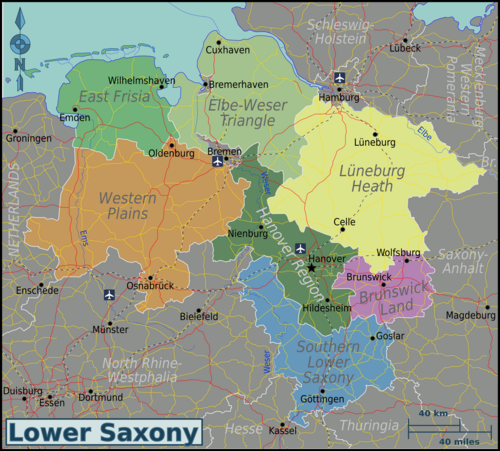
Lower Saxony, German Niedersachsen, ![Lower Saxony [Credit: © Bundesbildstelle/Press and Information Office of the Federal Government of Germany]](http://media-2.web.britannica.com/eb-media/53/101853-004-B1F719AA.jpg) Land (state) ofGermany. The country’s second largest state in size, Lower Saxony occupies an important band of territory across the northwestern part of the country. It is bordered by theNorth Sea and the German states of Schleswig-Holsteinand Hamburg to the north and by the states ofMecklenburg–West Pomerania to the northeast, Saxony-Anhalt to the east, Thuringia and Hessen to the south, and North Rhine–Westphalia to the southwest. The Netherlands borders Lower Saxony to the west. The state of Bremen, formed by the cities of Bremerhaven (at the mouth of the Weser) and Bremen (40 miles [64 km] up the river), is an enclave within Lower Saxony. Lower Saxony was established on November 1, 1946, by the British military government, which merged the former Prussian province of Hanover with the states of Braunschweig, Oldenburg, andSchaumburg-Lippe. Its capital is Hannover.
Land (state) ofGermany. The country’s second largest state in size, Lower Saxony occupies an important band of territory across the northwestern part of the country. It is bordered by theNorth Sea and the German states of Schleswig-Holsteinand Hamburg to the north and by the states ofMecklenburg–West Pomerania to the northeast, Saxony-Anhalt to the east, Thuringia and Hessen to the south, and North Rhine–Westphalia to the southwest. The Netherlands borders Lower Saxony to the west. The state of Bremen, formed by the cities of Bremerhaven (at the mouth of the Weser) and Bremen (40 miles [64 km] up the river), is an enclave within Lower Saxony. Lower Saxony was established on November 1, 1946, by the British military government, which merged the former Prussian province of Hanover with the states of Braunschweig, Oldenburg, andSchaumburg-Lippe. Its capital is Hannover.
Land (state) ofGermany. The country’s second largest state in size, Lower Saxony occupies an important band of territory across the northwestern part of the country. It is bordered by theNorth Sea and the German states of Schleswig-Holsteinand Hamburg to the north and by the states ofMecklenburg–West Pomerania to the northeast, Saxony-Anhalt to the east, Thuringia and Hessen to the south, and North Rhine–Westphalia to the southwest. The Netherlands borders Lower Saxony to the west. The state of Bremen, formed by the cities of Bremerhaven (at the mouth of the Weser) and Bremen (40 miles [64 km] up the river), is an enclave within Lower Saxony. Lower Saxony was established on November 1, 1946, by the British military government, which merged the former Prussian province of Hanover with the states of Braunschweig, Oldenburg, andSchaumburg-Lippe. Its capital is Hannover.Physical features
With the exception of a small highland area to the south, the landscape of the state is dominated by the great North German Plain. Much of the state’s northern half consists of sandy lowlands of heath, bog, and polder, interspersed with scattered forests. In the northwest the East Frisian Islands—12 islands in the North Sea—and about 325 square miles (840 square km) of coastal land are actually below sea level and are protected from inundation by dikes similar to those nearby in the Netherlands. More than half of Lower Saxony is drained by the Weser River and its tributaries, the Fulda and the Werra. At the mouths of the Weser and other rivers flowing into the North Sea, fertile marshes are found, mostly supporting a pasture economy. In the state’s northeastern region, there is a less-fertile area of land partly covered with forests. This contains the Lüneburg Heath(Lüneburger Heide), which is noted for its old-fashioned red farmhouses and the ancient megalithic structures known as “graves of giants.” In the south-central part of the state are two sizable lakes: Steinhuder Lake (about 12 square miles [30 square km]) andDümmer Lake (about 6 square miles [15 square km]). The highland area occupies the southern portions of the state and contains the Weser, Deister, and Harz mountains. The important Mittelland Canal runs east-west across the south-central part of Lower Saxony.
The sandy lowlands of the north are sparsely populated in comparison with the south-central belt. The troughlike valleys of the forested southern uplands provide good-quality agricultural land, as do the foothills farther north. The latter form part of a treeless belt of rich loess soils known as the Börde, which runs in a narrow east-west zone across the state. Lower Saxony’s climate offers mild winters, moderately warm summers, and a steady year-round rainfall ranging from 24 to 35 inches (600 to 900 mm).
People
The population of Lower Saxony regards itself as Low German, linked by a common ancient Saxon origin and the use of the Low German dialect known as Plattdeutsch. The latter, a dialect closely related to Dutch, Frisian, and English, is quite distinct from the official High German (see also German language). Some regional literature is still written in this dialect, and it remains the language of the home in much of the state. About four-fifths of the population is Protestant, with a Roman Catholic minority in the state’s western part.
