jricho during bronza age
Bronze Age[edit]
- This section deals with the archaeology of Bronze Age Jericho; for the Biblical battle, see Battle of Jericho
A succession of settlements followed from 4500 BCE onward, the largest constructed in 2600 BCE.[19]
Jericho was continually occupied into the Middle Bronze Age; it was destroyed in the Late Bronze, after which it no longer served as an urban centre. The city was surrounded by extensive defensive walls strengthened with rectangular towers, and possessed an extensive cemetery with vertical shaft-tombs and underground burial chambers; the elaborate funeral offerings in some of these may reflect the emergence of local kings.[33]
During the Middle Bronze Age Jericho was a small prominent city of the Canaan region, reaching its greatest Bronze Age extent in the period from 1700 to 1550 BCE. It seems to have reflected the greater urbanization in the area at that time, and has been linked to the rise of the Maryannu, a class of chariot-using aristocrats linked to the rise of theMitannite state to the north. Kathleen Kenyon reported "...the Middle Bronze Age is perhaps the most prosperous in the whole history of Kna'an. ... The defenses ... belong to a fairly advanced date in that period" and there was "a massive stone revetment... part of a complex system" of defenses (pp. 213–218).[34] Bronze-Age Jericho fell in the 16th century at the end of the Middle Bronze Age, the calibrated carbon remains from its City-IV destruction layer dating to 1617–1530 BCE. Notably this carbon dating c. 1573 BCE confirmed the accuracy of the stratigraphical dating c. 1550 by Kenyon.
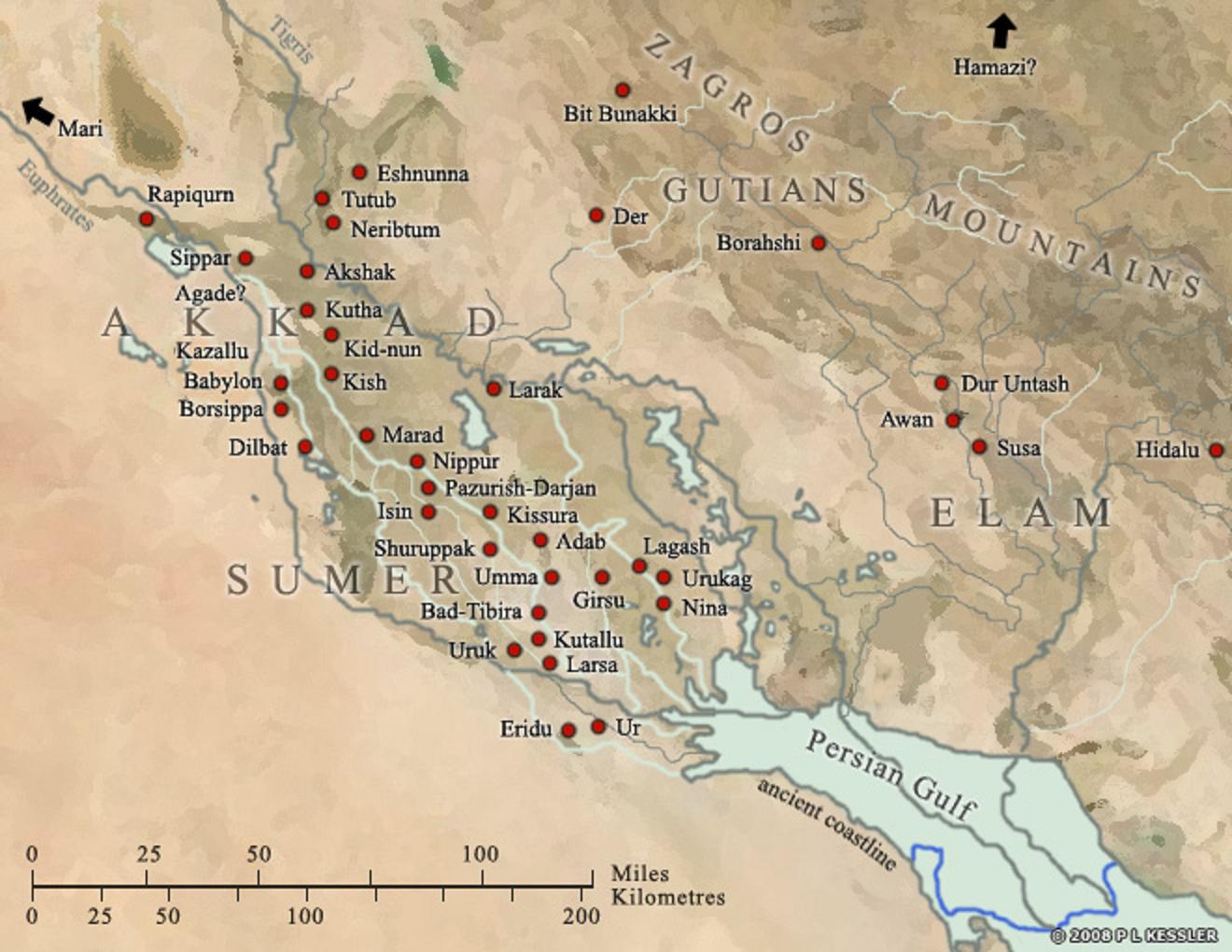
SUMERIAN CITIES
Sumer was an ancient Chalcolithic civilization that saw its artistic styles change throughout different periods in its history.
Source: Boundless. “The Mesopotamian Cultures.” Boundless Art History. Boundless, 13 Apr. 2016. Retrieved 15 May. 2016 from https://www.boundless.com/art-history/textbooks/boundless-art-history-textbook/art-of-the-ancient-near-east-3/mesopotamia-49/the-mesopotamian-cultures-283-10988/
ERIDU


place of origin on the northern fringes of the Fertile Crescent, Neolithic farmers started filtering into the Fertile Crescent itself. Although this broad plain received insufficient rainfall to support agriculture, the eastern section was watered by the Tigris and Euphrates rivers. Known in ancient days as Mesopotamia (Greek for "between the rivers"), the lower reaches of this plain, beginning near the point where the two rivers nearly converge, was called Babylonia. Babylonia in turn encompassed two geographical areas - Akkad in the north and Sumer, the delta of this river system, in the south.
Broken by river channels teeming with fish and re-fertilized frequently by alluvial silt laid down by uncontrolled floods, Sumer had a splendid agricultural potential if the environmental problems could be solved. "Arable land had literally to be created out of a chaos of swamps and sand banks by a 'separation' of land from water; the swamps ... drained; the floods controlled; and lifegiving waters led to the rainless desert by artificial canals." ^4 In the course of the several successive cultural phases that followed the arrival of the first Neolithic farmers, these and other related problems were solved by cooperative effort. Between 3500 B.C. and 3100 B.C. the foundations were laid for a type of economy and social order markedly different from anything previously known. This far more complex culture, based on large urban centers rather than simple villages, is what we associate with civilization.
Third Dynasty of Ur[edit]
Main article: Third Dynasty of Ur
The Third Dynasty of Ur is dated to ca. 2047–1940 BC short chronology. Ur-Nammu of Ur defeated Utu-hegal of Uruk and founded the Third Dynasty of Ur. Although the Sumerian language ("Emegir") was again made official, Sumerian identity was already in decline, as the population became continually more and more Semiticised.[citation needed]
After the Ur III dynasty was destroyed by the Elamites in 2004 BC, a fierce rivalry developed between the city-states of Larsa, more under Elamite than Sumerian influence, and Isin, that was more Amorite (as the Western Semitic nomads were called). Archaeologically, the fall of the Ur III dynasty corresponds to the beginning of the Middle Bronze Age. The Semites ended up prevailing in Mesopotamia by the time of Hammurabi of Babylon, who founded the BabylonianEmpire, and the language and name of Sumer gradually passed into the realm of antiquarian scholars. Nevertheless, Sumerian influence on Babylonia, and all subsequent cultures in the region, was undeniably great.
During the third millennium BC, there developed a very intimate cultural symbiosis between the Sumerians and the Akkadians, which included widespread bilingualism.[22] The influence of Sumerian on Akkadian (and vice versa) is evident in all areas, from lexical borrowing on a massive scale, to syntactic, morphological, and phonological convergence.[22] This has prompted scholars to refer to Sumerian and Akkadian in the third millennium as asprachbund.[22]
Akkadian gradually replaced Sumerian as the spoken language of Mesopotamia somewhere around the turn of the third and the second millennium BC (the exact dating being a matter of debate),[23] but Sumerian continued to be used as a sacred, ceremonial, literary and scientific language in Mesopotamia until the first century AD.

No comments:
Post a Comment