arius was prepared for battle having selected this spot to meet his enemy.
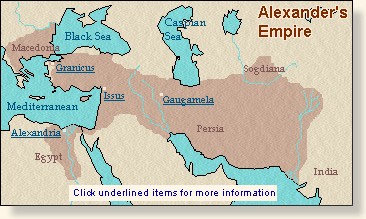 After his defeat at Issus two years previously, Darius made sure that this battleground favored his army and its tactics - particularly the use of his feared scythe-wheeled chariots. The ground here was flat, perfect for chariots. Darius made it even flatter by ordering the terrain plowed and leveled. All was ready and on October 1, 331 BC the Persian army of possibly 200,000 (ancient texts exaggerate the number up to 1 million) faced off against Alexander's 35,000. The Macedonian leader immediately sized up the Persian's tactical advantage and countered by ordering his cavalry to shift to the right hoping to move his enemy away from its flat field. Darius took the bait ordering his troops to follow. Soon the Persians found themselves on rough, rock-strewn terrain. Seeing the thinning Persian line, Alexander led the charge that crashed through to the Persian rear. As at the battle of Issus, Darius fled, leaving the field and victory to Alexande
The Battle of Gaugamela
The following description of the battle of Gaugamela was written by the Greek historian Arrian in the second century AD. His account is based on contemporary sources and is considered well written and accurate:
"When the armies drew near each other, Darius and the men especially around him were observed opposite Alexander himself and his royal squadron of cavalry. Alexander led his own army more towards the right, and the Persians marched parallel along with him, far outflanking him upon their left. Then the Scythian cavalry rode along the line and came into conflict with the front men of Alexander's army; nevertheless he still continued to march towards the right, and almost entirely got beyond the ground that had been cleared and leveled by the Persians. Then Darius, fearing that his chariots would become useless if the Macedonians advanced upon the uneven ground, ordered the front ranks of his left wing to ride round the right wing of the Macedonians, where Alexander was commanding, to prevent him from marching his wing any further.
Darius unleashes
his scythed-wheeled chariots |
[Translator's note: This led to countermoves by Alexander and precipitated a general cavalry engagement; the Greeks suffered severely, but sustained the assaults, and] assailing the enemy violently squadron by squadron, succeeded in pushing them out of rank. Meanwhile the Barbarians launched the scythed-chariots against Alexander himself, to throw his phalanx into confusion; but in this they were grievously deceived. For as soon as they approached the [Macedonian] javelin men, who had been posted in front of the 'Companion' cavalry, hurled their darts at some of the horses; others they seized by the reins and pulled the drivers off, and standing round the horses killed them. Yet some got right through the ranks; for the men stood apart, and opened their ranks, as they had been taught, wherever the chariots attacked. Thus commonly the chariots went through safely, and their drivers were unhurt, but the [rear guard] later overpowered them.

No comments:
Post a Comment